- Steffen Cruz guest lecture on Room Acoustics> 2015
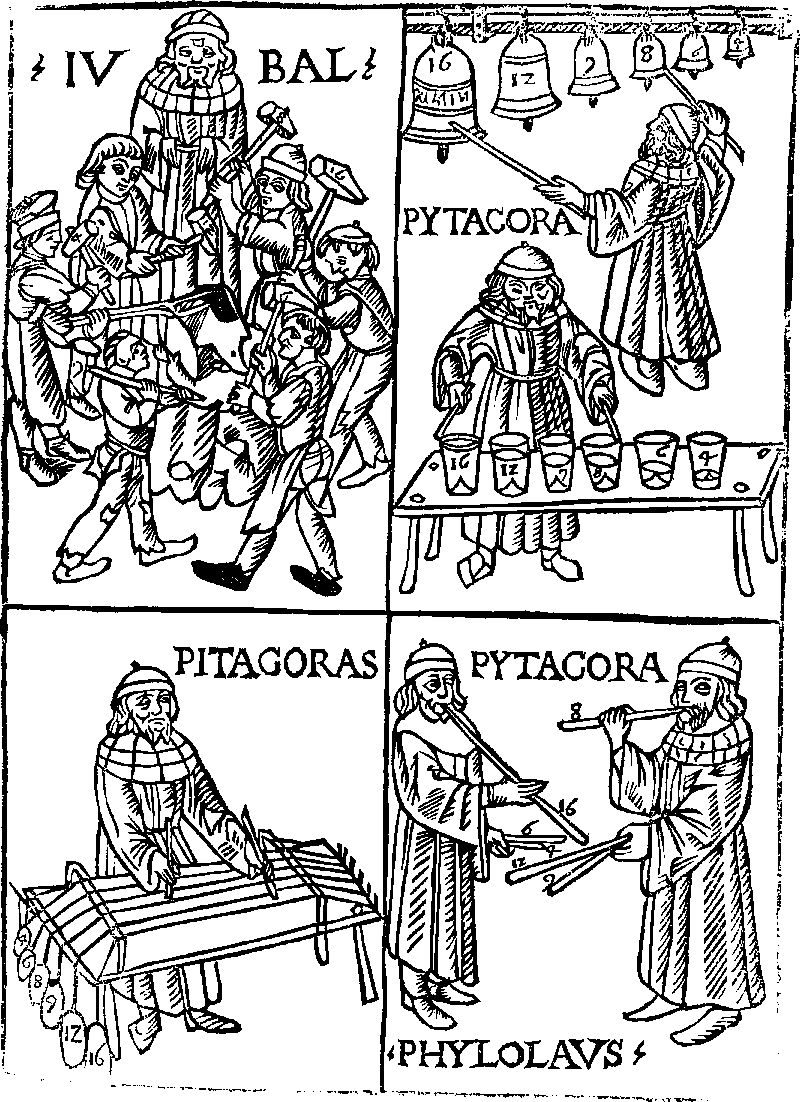
- Temperaments
- Intervals recodings of intervals in the various temperaments (Just, Pythagorian, equal)
- Just tuning
- Ross
Duffin on the use of Just Temperament in Renaissance
music. He is almost as opinionated as I am. See especially:
Benedetti's Puzzle ( HTML5 version ) for an example where a succession of four chords repeated each tuned to Just tuning, keeps rising in pitch because the just minor third is very sharp compared with the equal tempered or Pythagorian minor third. Ie, if all perfect fourth and fifth intervals, and the minor third are kept at true just ratios, the successive runs of these chords rise in pitch by about 1/6 of a semitone each time through.
Is Just tuning possible> ( HTML5 version)which demonstrates the Hilliard Ensemble singing "The Lamentations of Jeremiah" in pure Just tuning. Note the purity of the especially the last major third chord. (E2-E3-G4#-B4-E5) - Ross Duffin has a large collection of articles and examples of Just tuning, of the various temperaments and of the effects of these on Music tradition. His article on Valotti-Young pitches the idea that other temperaments might have been used and be useful for late Baroque and early Classical music. The examples he give are worth the the cost of entry.
- Ross
Duffin on the use of Just Temperament in Renaissance
music. He is almost as opinionated as I am. See especially:
- Bach's temperament Bradley Lehman has argued
that we know what temperament Back used for his "Well Tempered Clavier". It is
not equal temperament, but one in which the various keys have different
feelings, but all keys are useable. This
paper is also a good introduction to temperaments.
He bases his proposal on a "doodle" on the title page of the Well Tempered Clavier
where the different types of loops represent different temperings of the intervals between the fifths. The doodles are read from right to left, with the letter C beneath the doodle indicating where the C lies. (The big loop with an internal double loop represents 1/6 of a comma flattened from the just-3/2 ratio, The loops with an internal single loop represents 1/12 of a comma flattened and this leaves the last fifth between Bb and F sharpened by 1/12 of a comma. the loops with no internal loops represent a just fifth. ( The comma is the difference between the tuning of 7 octaves (2:1 ratio 7 times) and 12 perfect fifths (3:2 ration done 12 times). The comma corresponds to a frequency ratio of 1.013 or just under a quarter of a semitone. Equal temprament has each of the fifths on a keyboard flattened from the just 3:2 interval by 1/12 of a Pythagorian comma, a frequency ratio of 1.0011 That the human ear can tell such a small "mistuning" is a tribute to the incredible sensitivity of the human hearing.)
Here is the doodle with the notes (fifths) labeled below

For Lehman's take on other's proposals see http://www-personal.umich.edu/~bpl/larips/bachtemps.html
For another interpretation of this doodle as a termperament see Luigi Swich, "Further thoughts on Bach's 1722 temperament" Early Music, 39 401 (2011) doi: 10.1093/em/car041.
(This link is only useable by UBC people with a CWL password or some other way of using JSTOR) What all of the proposals for Bach's temprament share is that different keys signatures sound differently, though all are useable. What the changing temperaments (like Bach's) have is that the same interval (eg a major third) sound slightly differently depending on what note they start on. A composer can use these differences to enhance the music. I for example find Bach's prelude (see below) more interesting and varied because of those changes in the various intervals throughout the piece. However this also means that the piece cannot be transposed (played in a different key) on such an instrument because it would sound very different if one did so. Intervals and chords which the composer wanted to sound calm and pure would sound slightly discordant, while other, where the composer wanted that slight discord, would sound too smooth and pure.Here is Bach's Prelude C major, no. 1 from the Well Tempered Clavier, played in the Lehman-Bach temperament, equal temperament, and another unequal temperament (Werkmeister III) from the the 18th century, played via midi, so all three are exactly the same as far as the notes that are played, it is just the tunings that differ. It is best to page through the file and play similar sections in each of the tunings to compare them. Or Just try to get a feel for the piece, esp the tone colour and feel of the piece in the different temperament. This piece is in the key that comes closest to just tuning in this temperament as opposed to equal temperament although the modulation throught means that one is effectively hearing many different keys in the one piece. The form of the piece means it could easily become boring (and for me does a bit in equal temperament) but the slight varitions in tunings of intervals throught the piece make the Lehman much more interesting for me. Sometimes the major thirds are sharp and bright, sometimes more sombre. Similarly the minor thirds can be brighter of more closed. Listen also to the C major final chord at the end of the piece. It is more harmonious (less beating or wavering) in the Lehman than the equal temperament.
Here is the last 17 seconds of that Prelude #1 from above in the Lehman Temperament and in Equal temperament. I find the Lehman more interesting-- there is more variety-- tnan in equal temperament. But see what you think. Listen also to the last chords in each case. (Note that these require an HTML5 aware browser which also understands .wav files. Almost all, except Internet Explorer, do, even though Microsoft invented the .wav files. )
Lehman :
Equal :
- Moonlight Sonatta in C#minor, Cminor and Dminor on a fortepiano (brass
strings which are far more harmonious than steel strings of modern pianos)
tuned to Vallote-Young temperament. The different keys have very different
major and minor thirds and fifths and fourths when compared to each other,
giving the piece a very different tonal and emotional feel in the differnt
keys. (This would not happen in equal temperament).
C#minor is a remote key-- "far away" from C major (or A minor, C major's related
minor key) where one would expect large deviations from just tuning. (These
were recorded on a UBC owned fortepiano played by Pat Unruh and tuned by Hans
Krebs tuned to the Valotte Young temperament.)
- C# Minor The key Beethoven wrote it for
- C Minor One semitone down
- D Minor One semitone up
- C# Minor on a modern Grand piano whch played on an equal temperered grand piano with its steel strings whose harmonics are out of tume with the fundamental. For me it sounds far muddier than on a fortepiano partly also because of the long decay time of the piano strings, and possibly also the "mistuning" of the two or three strings used in the modern piano to help give it loudness. (That mistuning is not a mistake but must happen. It is called "avoided level crossing" in physics. It is impossible to tune both strings exactly the same because of interactions between the strings). The fortepiano has only one string per note.
Temperaments and Tuning
- Introduction Negative Damping
- Clarinet
- Trumpet
- Flute
- Violin